בָּרוּךְ אַתָּה יְיָ אֱלֹהֵֽינוּ מֶֽלֶךְ הָעוֹלָם שֶׁהֶחֱיָנוּ וְקִיְּמָנוּ וְהִגִּיעָנוּ לזְּמַן הַזֶּה.

Bārūch atāh Adonai Elohênū melekh ha`ôlām šeheḥeyānû veqîmānû vehigî`ānû lazman hazeh

Blessed art thou, O Lord our God, king of the universe, who hast given us life and sustained us and brought us to this season

Showing posts with label Huntsman translation. Show all posts

Saturday, April 4, 2026

Readings for Easter Sunday


Episodes

  • The Women and the Empty Tomb (Mark 16:1–8; parallels Matthew 28:1–10; Luke 24:1–11)
  • Mary Magdalene, Peter, and the Beloved Disciple at the Tomb (Luke 24:12; John 20:1–10)
  • Mary Magdalene and the Risen Lord (John 20:11–18; Mark 16:9–11[Longer Ending])
  • Two Disciples on the Road to Emmaus (Luke 24:13–35; Mark 16:12–13[Longer Ending])
  • First Appearances to the Disciples in Jerusalem (Luke 24:36–48; parallel Mark 16:14[Longer Ending]; John 20:20–25)
  • Jesus Later Appears to Thomas (John 20:26–29)
  • The Purpose of the Gospel according to John (John 20:30–31)


 William-Adolphe Bouguereau, "Women at the Tomb"

The Women at the Tomb: Mark 16:1–8; Matthew 28:1–15; Luke 24:1–11

Because of the important contributions of each of the Synoptic accounts of the empty tomb, we have included all three here. The earliest account from Mark is also—at least in the most secure manuscript traditions—the shortest, leaving the women who came to the tomb fleeing it amazement. Matthew’s version provides the additional detail of an angel descending to remove the stone that blocked the tomb’s entrance, frightening the guards. It also records an appearance of the Risen Lord as the women went to tell the other disciples that the tomb was empty. In many ways Luke’s is the most refined, and it also includes an element that we will see is common to John’s account, that of Peter’s visit to the empty tomb.

See the discussion in Greater Love Hath No Man, 212–218.

Mark

16

1Now when the Sabbath was over, Mary of Magdala, Mary the mother of James, and Salome bought spices so that they might go and anoint him. 2Then very early in the morning on the first day of the week, after the sun had risen, they came to the tomb. 3They began to say to each other, “Who will remove the stone from the entrance of the tomb for us?” 4Yet when they looked up, they saw that the stone—which was very large—had already been dislodged. 5Then after they had gone into the tomb, they saw a young man dressed in a long white robe sitting on the right side, and they were alarmed. 6But he said to them, “Don’t be alarmed! You are looking for Jesus of Nazareth, who was crucified. He has risen and is not here! See the place where they laid him. 7Now go, tell his disciples, and Peter, that he is going ahead of you to Galilee. There you will see him, just as he told you.” 8Then, having gone out of the tomb, they fled, for they were out of their wits with amazement, and they did not say anything to anyone, because they were afraid.


Matthew

28

 1After the Sabbath, as the first day of the week dawned, Mary of Magdala and the other Mary came to see the tomb. 2Then look, a great earthquake occurred! For an angel of the Lord, who had descended from heaven and come to the tomb, dislodged the stone and sat on top of it. 3Now his face was like lightning, and his clothing was as white as snow. 4The men who were on guard were shaken out of fear of him, and they became like dead men. In response, the angel said to the women, “Do not be afraid! I know that you are looking for Jesus, who was crucified. 6He is not here, for he has risen just as he said. Come, see the place where he lay! 7Now go quickly and tell his disciples that he has been raised from the dead, and look, he is going ahead of you into Galilee! There you will see him. Look, I have told you!”

8Then after they had quickly left the tomb, with both fear and great joy they ran to make the proclamation to his disciples. 9Then look, Jesus met them, saying “Rejoice!” When they came up to him, they took hold of his feet and worshipped him. 10Jesus said to them, “Do not be afraid. Go, proclaim to my brothers that they should go to Galilee. There they will see me.”

11Now as they were going, look, when some of the guard had gone into the city, they reported to the chief priests all that had happened. 12After the chief priests had gathered with the elders and made a plan, they gave a large sum of money to the soldiers, 13saying, “This is what you should say: When his disciples came during the night, they stole him while we were sleeping,’ 14and if this is heard by the governor, we will reassure him and keep you out of trouble.” 15So after they had taken the money, they did as they had been directed, and this story has been spread widely among the Jews until today.


Luke

24

 1On the first day of the week, very early in the morning, they came to the tomb, bringing the spices that they had prepared. 2Then they found that the stone had been dislodged from the tomb. 3Yet when they entered it, they did not find the body of the Lord Jesus. 4While they were uncertain as to what this meant, look, two men in gleaming clothing suddenly stood near them. 5Now while the women were afraid and were bowing their faces to the ground, the men said to them, “Why are you looking for one who is alive among the dead? 6He is not here but has risen! Remember what he said to you when he was still in Galilee, 7saying, ‘The Son of Man must be handed over into the power of sinful men, and be crucified, and on the third day rise again.’” 8Then they remembered his predictions.

9When they had returned from the tomb, they proclaimed all these things to the Eleven and all the others. 10Now they were Mary of Magdala, Joanna, Mary the mother of James, and the other women with them—they told the apostles, 11but these reports seemed to them to be nonsense, and they refused to believe them. 12Peter, however, got up and ran to the tomb, but when he stooped down to look, he only saw the linen wrappings. Then he went home, wondering to himself about what had happened.


Harry Anderson, "Mary Magdalene and the Risen Lord"


Mary Magdalene, the Empty Tomb, and the Risen Lord: John 20:1–18

John’s account of the events at the empty tomb that first Easter morning is different enough to warrant particular attention. First, it portrays Mary of Magdala coming to the tomb alone, without the other women. She informs the male disciples, which leads Peter and the Beloved Disciple to come to the tomb (although we have seen that Luke preserves an independent memory of Peter visiting the burial site). Second, it records the moving encounter of Mary with the Risen Lord, a unique scene with particular power and significant interpretive potential.

See the discussion in Greater Love Hath No Man, 218–224.

John

20

1On the first day of the week, early in the morning Mary of Magdala came to the tomb when it was yet dark, and she saw that the stone had been removed from the tomb. 2She ran and came to Simon Peter and to the other disciple, the one whom Jesus loved, and said to them, “They have taken the Lord from the tomb, and we do not know where they have laid him.”

3So Peter and the other disciple set out and came to the tomb. 4Now the two had been running together, but the other disciple ran more quickly than Peter and arrived at the tomb first. 5After he had stooped down to look, he saw the linen wrappings lying there, though he did not go in. 6Then Simon Peter, who had been following him, arrived, went into the tomb, and saw the linen wrappings lying there 7as well as the face cloth, which had been on his head, not lying with the linen cloths but folded up in a place by itself. 8Then the other disciple, who had arrived at the tomb first, also went in, and he both saw and believed, 9for they had not known before this time the scripture that he must rise again from the dead. 10Then the disciples went back to where they had been staying.

11Mary, however, remained standing there outside the tomb, mourning. As she mourned, she stooped to look into the tomb 12and saw two angels in white sitting there, one at the head and one at the feet, where the body of Jesus had been lying. 13They said to her, “Woman, why are you mourning?” She said to them, “They have taken my Lord, and I do not know where they have laid him.”

14After she had said these things, she turned herself around and saw Jesus standing there, but she did not know that it was Jesus. 15Jesus said to her, “Woman, why are you mourning? Whom are you looking for?” She, thinking that he was the gardener, said to him, “Sir, if you have carried him away, tell me where you have laid him, and I will take him.” 16Jesus said to her, “Mary!” After she turned towards him, she said in Aramaic, “Rabbouni!” that is to say, “My Master!” 17Jesus said to her, “Stop clinging to me! I have not yet ascended to my Father. Go to my brothers and sisters and say to them, ‘I am ascending to my Father and your Father, to my God and to your God.’

18Mary of Magdala went, proclaiming to the disciples, “I have seen the Lord” and the things he had said to her.


 J. Kirk Richards, "Road to Emmaus"

Two Disciples on the Road to Emmaus: Luke 24:1335

Unique to Luke is the episode about two disciples who encounter the Risen Lord on the road to Emmaus. This account is significant because, like the story about Mary of Magdala, it emphasizes the witness of everyday disciples rather than just the special apostolic witnesses of the remaining members of the Twelve.

See the discussion in Greater Love Hath No Man, 224–28.

Luke

24

13Now look, that same day two of them were traveling to a village named Emmaus, which was about seven miles from Jerusalem, 14and they were talking together about all these things that had happened. 15Then it came about that while they were talking together and discussing it, Jesus himself, after he had come up to them, started walking with them. 16But their eyes were kept from recognizing him. 17He said to them, “What are these things that you are discussing as you walk along?” Then they stood still, looking downcast. 18One of them, Cleopas by name, said to him in response, “Are you only a visitor in Jerusalem, one who does not even know what has happened these past days?”

19Then he asked them, “What sort of things?” They answered him, “All about Jesus from Nazareth, who was a prophet powerful in deed and in word before God and all the people. 20Also, how our chief priests and rulers handed him over to a death sentence and crucified him, 21but we had been hoping that he himself was about to redeem Israel. Yet as it happens, it is now the third day since all these things happened. 22But now, some women from our group have confused us. When they were at the tomb early in the morning 23and did not find his body there, they came back, telling us they had even seen a vision of angels, who told them that he was alive! 24And some of those who were with us went to the tomb, and they found it just as they women had described, but they did not see him.”

25Then he himself said to them, “O, how foolish you are and slow in heart to believe all the things that the prophets have declared! 26Didn’t the Christ need to suffer these things to enter into his glory?” 27Then, beginning with Moses and all the prophets, he began to explain everything about himself in the scriptures.

28Then they came up to the village where they had been heading, but he walked as if he would go farther. 29But they prevailed upon him, saying, “Please stay with us, because it is nearly evening and the day is waning.” So he went inside to stay with them. 30And it came about that while he was reclining at dinner with them, after he took some bread, he blessed it, and after he broke it, he gave it to them. 31Then their eyes were opened, and they recognized him, but he vanished from their sight. 32So they said to each other, “Weren’t our hearts burning within us as he spoke to us along the road, and as he opened up the meaning of the scriptures to us?”

33Getting up that very hour, they returned to Jerusalem and found the Eleven and those who were with them gathered together, 34who told them, “The Lord has arisen indeed, and he has appeared to Simon!” 35And these men, for their part, related all the things that had transpired along the road, and especially how he was recognized by them in the breaking of bread.


Carl Bloch, "The Doubting Thomas"


First Appearances to the Disciples in Jerusalem: Luke 24:36–49; John 20:19–31

Only Luke and John provide accounts of a visit later that day to the disciples. In both versions he gives them tangible proof that he has bodily risen from the dead.

See the discussion in Greater Love Hath No Man, 228–232.

Luke

24

36Then, while they were talking about these things, Jesus himself stood in the middle of them and said to them, “Peace be with you!” 37But they, alarmed and frightened, thought they were seeing a spirit. 38He said to them, “Why are you troubled, and why are doubts arising in your hearts? 39Look at my hands and my feet, how it is really me! Touch me and see, for a spirit does not have flesh and bones as you see that I have.” 40After he had said this, he presented his hands and feet to them.

41While they could hardly believe it because of their joy and were still marveling, he asked them, “Do you have anything here to eat?” 42So they gave him a piece of broiled fish. 43After he picked it up, he ate it in front of them. 44Next he said to them, “This is the meaning of the sayings that I spoke to you while I was still with you, how all that was written about me in the law of Moses, in the prophets, and in the psalms must be fulfilled.” 45Then he opened up their minds so that they could understand the scriptures. 46He told them, “Thus it was written that the Christ must suffer and rise again on the third day 47and that repentance for the forgiveness of sins must be preached in his name to all nations, starting in Jerusalem. 48You are witnesses of these things. 49Look, I am sending what my Father has promised to you, but stay here in the city until you are clothed with power from on high.”


John

20

 19When it was evening on that same day, the first day of the week, and when the doors of the room were shut where the disciples were because of fear of “the Jews,” Jesus came, stood among them, and said, “Peace be with you!” 20After he had said this, he showed them his hands and his side. The disciples were filled with joy because they had seen the Lord! 21So he said to them again, “Peace be with you. Just as the Father sent me, I also am sending you.” 22After he had said this, he breathed on them and said, “Receive the Holy Spirit. 23Whosever sins you forgive will be forgiven for them; whosever sins you retain will be retained.”

24Yet Thomas, one of the Twelve, who was called “the Twin,” was not with them when Jesus came. 25So the other disciples said to him, “We have seen the Lord!” He said to them, “Unless I see the mark of the nails in his hands, put my finger into the mark of the nails, and put my hand in his side, I will never believe.”

26Then eight days later the disciples were inside again, and Thomas was with them. Even though the doors were shut, Jesus came, stood in the middle of them, and said, “Peace be with you!” 27Then he said to Thomas, “Bring your finger here and see my hands, and bring your hand here and put it in my side. Stop being unbelieving but be believing!” 28Thomas responded and said to him, “My Lord and my God!” 29Jesus said to him, “Have you come to believe because you have seen me? Fortunate are those who do not see yet believe.”

30Now there were many other signs that Jesus performed in the presence of his disciples, which have not been written in this book. 31But these have been written so that you may continue to believe that Jesus is the Christ, the Son of God, and that by believing you may have life in his name.

Wednesday, April 1, 2026

Readings for Wednesday


Episodes

  • The Plot to Kill Jesus (Mark 14:1–2; parallels Matt 26:1–5; Luke 22:1–2)
  • An Unnamed Woman Anoints Jesus (Mark 14:3–9; Matt 26:6–13)
  • Judas Agrees to Betray Jesus (Matt 26:14–16; parallels Mark 14:10–11; Luke 22:3–6)


Conspiracy and an Anointing: Mark 14:111

The story of the unnamed woman who anointed Jesus’ head in Bethany (Mark 14:3–9; parallel Matt 26:6–13) is framed by the plot of the Jerusalem authorities to put Jesus to death (Mark 14:1–2; parallels Matt 26:1–5; Luke 22:1–2) and the decision of Judas Iscariot to hand Jesus over to them (Mark 14:10–11; parallels Matt 26:14–16; Luke 22:3–6).

See the discussion in Greater Love Hath No Man, 90–98.

James Tissot, "Conspiracy of the Jews"

14

1Now when the Passover and the Feast of Unleavened Bread were two days away, the chief priests and the experts at the law began to deliberate how they could take him by cunning and put him to death, 2for they said, “Not during the festival so that there will not be a commotion among the people.”


J. Kirk Richards, "Alabaster Box"

3While he was in Bethany in the house of Simon the leper, as he was reclining at the dinner table, a woman who had an alabaster flask of very expensive ointment of pure nard came in. After breaking the flask, she poured it on his head. 4There were some who began to complain indignantly to each other, saying, “Why has this ointment been wasted? 5For this ointment could have been sold for over three hundred denarii and given to the poor.” And they scolded her. 6But Jesus said, “Leave her alone. Why are you distressing her? She has done a fine thing for me. 7For you always have the poor with you, and whenever you want, you can do something good for them, but you do not always have me. 8She has done what she could: she has anointed my body ahead of time for its burial. 9Truly, I say to you, wherever the good news is proclaimed throughout the whole world, this also which she has done will be recounted in her memory.”


Giotto, "Payment of Judas"

10Then Judas Iscariot, one of the Twelve, went to the chief priests to hand him over. 11When they heard this, they were delighted and promised to give him money. So he began to look for a convenient opportunity to hand him over.


Tuesday, March 31, 2026

Readings for Tuesday


Episodes

  • Jesus Examined: Attempts to Catch Him in His Words (Mark 12:13–37; parallels Matt 22:15–46, Luke 20:20–47)
  • Hypocrisy of Jesus’ Opponents (Mark 12:38–40; parallels Matt 23:112; Luke 20:4547)
  •  Seven Prophetic Woes (Matt 23:1336)
  • The Widow’s Offering (Mark 12:41–44; parallel Luke 21:1–4)
  • Jesus’ Second Lament over Jerusalem (Matt 23:3739)
  •  The Olivet Discourse (Mark 13:1–38; parallels Matt 24:1–25:46; Luke 21:5–38)
  • [Summary of Jesus’ Teaching (Luke 21:37–38; John 12:37–50)]

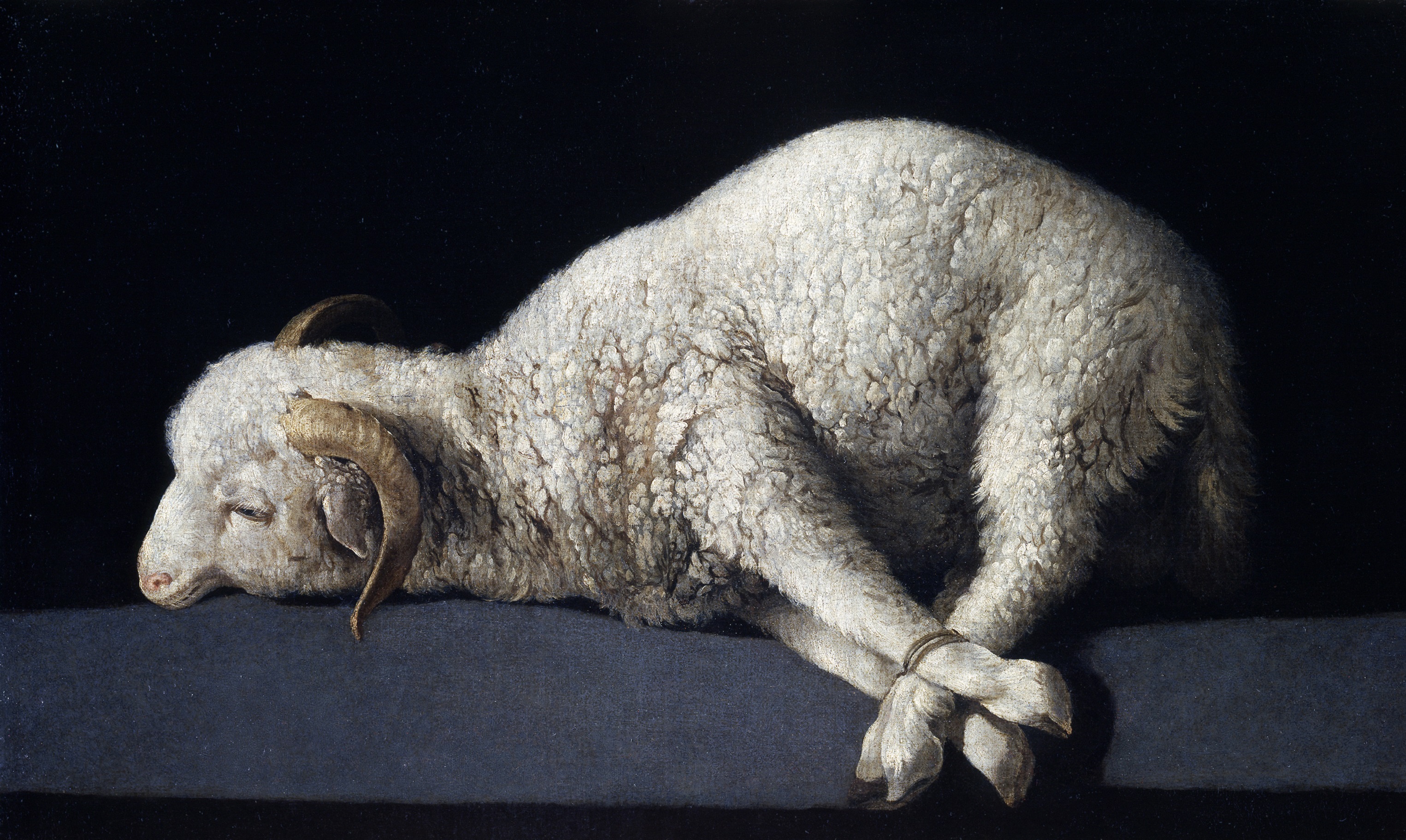
Francisco de Zurbarán, "Agnus Dei"
Just as the paschal lambs were observed in the days leading up to Passover, so did the chief
priests and scribes try to find fault with the True Lamb of God

Temple Teachings: Mark 12:13–44; Matthew 23:3739

The second set of Jesus’ temple teachings focus on his responses to questions posed to him by different groups within the ruling hierarchy, each of which tried to catch him in his words. Then, after posing a question of his own to them, he denounces them for their hypocrisy and contrasts them with the selfless faithfulness of a poor widow. The earliest versions of this material are preserved by Mark. Matthew adds a poignant lament that Jesus utters over Jerusalem.

See the discussion in Greater Love Hath No Man, 70–77.

Mark

12

13Next, they sent some of the Pharisees and of the Herodians to him to catch him in what he said. 14When they got there, they said to him, “Teacher, we know that you are truthful and are not partial to anyone, for you do not look upon the people's appearance but teach the way of God in truth. Is it permissible to pay a tax to Caesar or not? Should we pay or should we not pay?” 15Because he recognized their hypocrisy, he said to them, “Why are you testing me? Bring a denarius to me so I may see it.” 16So they brought it, and he said to them, “Whose image is this, and whose inscription?” They said to him, “Caesar’s.” 17Jesus said to them, “Give back to Caesar the things that are Caesar’s, and to God the things that are God’s.” And they were amazed at him.

18Then some Sadducees, who say that there is not a resurrection, came to him and questioned him, saying, 19“Teacher, Moses wrote to us, ‘If someone’s brother dies and leaves behind a wife but does not leave a child, his brother should marry the wife and raise up a posterity for his brother.’ 20There were seven brothers. The first married a wife and, when he died, did not leave any posterity. 21Next the second married her, and he died, not leaving a posterity. Then the third did the same thing. 22And so the seven men married her and did not leave any posterity. Last of all, the woman died, too. 23In the resurrection, to which of them will the wife belong? For seven men had her as wife.” 24Jesus said to them, “Is this not why you are making a mistake, because you understand neither the scriptures nor the power of God? 25For when they rise again from the dead, they neither enter into marriage nor are given in marriage, but they are like the angels in the heavens. 26But concerning the dead being raised, have you not read in the book of Moses how God spoke to him at the bush, saying, “I am the God of Abraham, and the God of Isaac, and the God of Jacob?” 27He is not the God of the dead but the God of the living. You are making a great mistake!”

28Next one of the experts at the law, when he had heard them debating and had seen that he had answered them well, came to him and asked him, “Which commandment is the most important of them all?” 29Jesus answered, “This is the first: ‘Hear, O Israel, the Lord our God, the Lord is one, 30and you shall love the Lord your God with your whole heart, with your whole soul, with your whole mind, and with your whole strength.’ 31This is the second: ‘You shall love your neighbor as yourself.’ There is not any commandment greater than these.” 32Then the expert at the law said, “Quite right, Teacher! You have spoken truly that he is one and there is no other except for him. 33Indeed loving him with the whole heart, and with the whole understanding, and with the whole strength, and loving your neighbor as yourself is greater than all the burnt offerings and sacrifices.” 34When Jesus saw that he had answered thoughtfully, he said to him, “You are not far from the kingdom of God!” After that no one dared to ask him anything.

35Then while Jesus was teaching in the temple, he said in response, “How can the experts at the law say that the Christ is the Son of David? 36David himself said by the Holy Spirit, ‘The Lord said to my lord, “Sit here at my right hand until I put your enemies under your feet.”’ 37David himself called him ‘lord.’ How then is he his son?” And the great crowd heard him gladly.

38So in his teaching he said, “Look out for experts at the law who take pleasure in walking about in long robes, receiving greetings in the marketplaces, 39having seats of honor in the synagogues, and getting places of honor at banquets. 40They are the ones who devour the houses of widows and make long prayers for the sake of appearance. These will receive much greater condemnation.”

41When Jesus had sat down across from the treasury, he saw how the crowd was putting money into the treasury, and many rich people were contributing a lot. 42When one poor widow came, she put in two small copper coins, which are worth a quadrans or penny. 43Calling his disciples to him, he said, “Truly, I say to you that this poor widow has put in more than all those who are putting into the treasury, 44for they have all contributed out of their abundance, but out of her poverty she put in all that she had, her whole means of subsistence.”

Matthew

23

37“Jerusalem, Jerusalem, you who kill the prophets and stone those who are sent to her! How often I wanted to gather your children together the way a hen gathers her chicks under her wings and you did not want me to! 38Look, your house is left empty! 39For I say to you, you will see me no longer until you say, ‘Blessed is the one who comes in the name of the Lord.’”


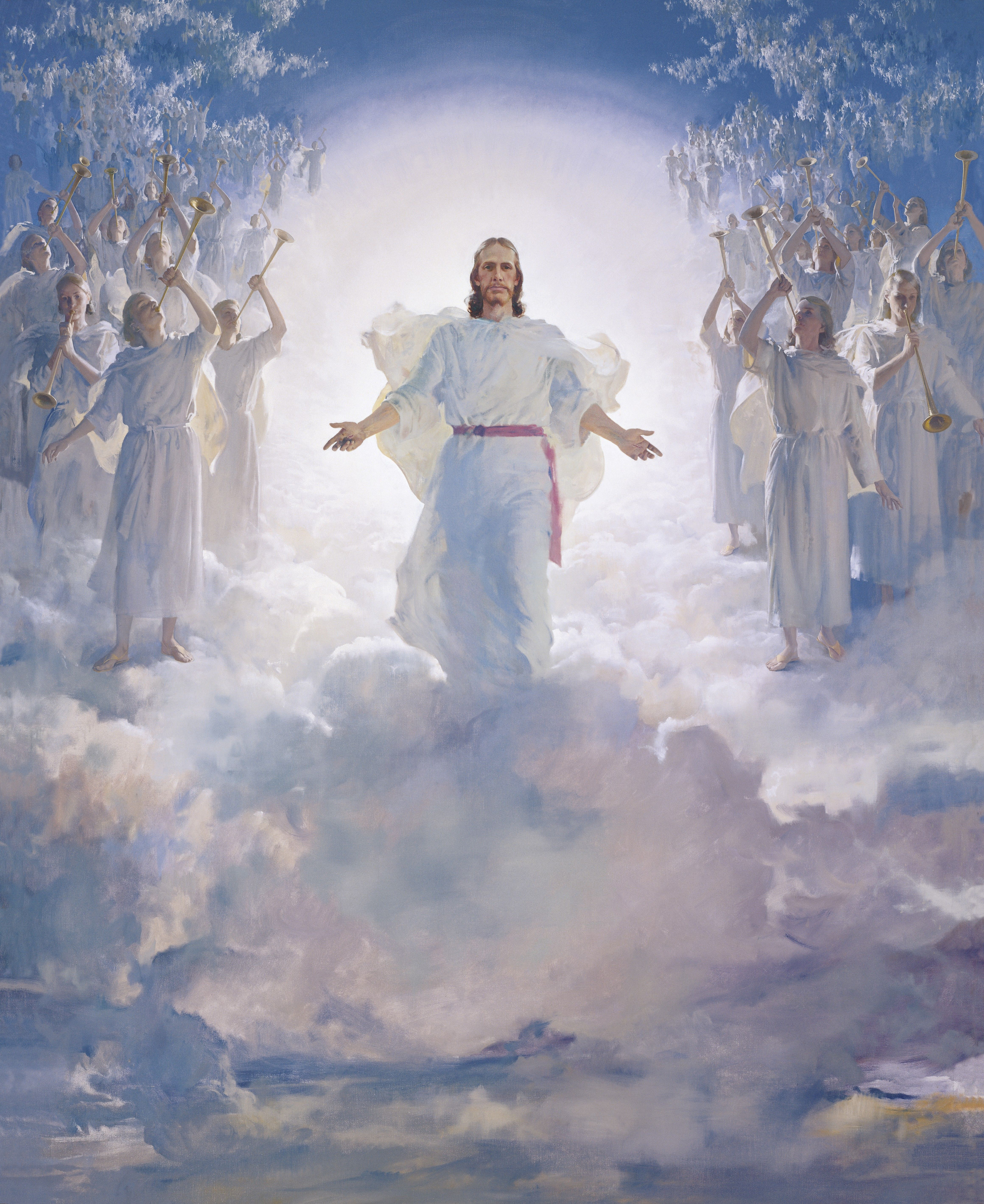
Harry Anderson, "The Second Coming of Christ"

The Olivet Discourse: Mark 13:1–37; Matthew 25:1–13, 31–46

Mark 13 comprises the longest single discourse of Jesus in that Gospel; elsewhere in Mark, Jesus’ sayings comprise short parables or teaching sayings. This discourse, which consists of a prophecy that Jesus delivered on the Mount of Olives, treats both the coming destruction of Jerusalem and the end of the world, before which Jesus will return in glory. Parallels appear in Matthew 24:1–25:46 and Luke 21:5–38. Matthew’s version is the longest of the three and includes several parables about preparing for the end, two of which are provided here.

See the discussion in Greater Love Hath No Man, 77–8

Mark

13

1As he was leaving the temple, one of his disciples said to him, “Teacher, look! What wonderful stones and buildings!” 2In response Jesus said to him, “Do you see these great buildings? A stone shall not be left here upon another stone that is not thrown down.”

3Then, as he was sitting on the Mount of Olives across from the temple, Peter, James, John, and Andrew began to ask him privately, 4“Tell us, when will these things happen, and what will the sign be when all these things are about to be fulfilled?” 5 Jesus began to say, “See to it that no one leads you astray. 6For many will come in my name who will say, ‘I am he!’ and they will lead many astray. 7Whenever you hear about wars and reports of wars, do not be upset. These must happen, but the end is not yet. 8For nation will rise up against nation, and kingdom against kingdom, and there will be earthquakes in various regions, and there will be famines. These are the beginning of labor pains.

9“But watch yourselves. They will hand you over to city councils, and you will be beaten in synagogues, and be arraigned before governors and kings on my account as a testimony to them. 10First the good news must be proclaimed to all nations. 11Yet whenever they arrest you and hand you over, do not be anxious about what you will say, but say whatever is given to you in that hour, for you are not the one who is speaking—it is rather the Holy Spirit. 12Now brother will hand over brother for death, and a father his child, and children will rise up in rebellion against their parents and put them to death. 13Then you will be hated by all on account of my name, but whoever stands his ground until the end will be saved.

14“But when you see the devastating sacrilege standing where it should not be—let the one who reads understand—then let those who are in Judea flee to the mountains, 15and let one who is on top of a house not go down or go into it to take anything out of the house, 16and let one who is in the field not turn back to pick up his cloak. 17But woe to those who are pregnant or who are nursing in those days! 18Pray that it does not happen during winter. 19For those will be days of affliction, such as have not occurred since God created the world until now and will not be again. 20Unless the Lord shortens those days, no mortal life would be saved, but because of the elect whom he has chosen, he has shortened those days. 21If anyone says at that time, ‘Look, the Christ is here, look, he is there!’ do not believe it. 22For false Christs and false prophets will appear, and they will perform miraculous signs and wonders to mislead, if possible, even the elect. 23But look out! I have warned you in advance about all these things.

24“But in those days, after that tribulation, ‘The sun will be darkened, and the moon will not give its light, 25and the stars will be falling from the sky,’ and the heavenly bodies will be shaken. 26Then they will see ‘the Son of Man as he comes in the clouds’ with great power and glory. 27Then he will send his angels and gather together his elect from the four winds, from the ends of the earth to the ends of the sky.

28“From the fig tree, learn a parable: When its branch becomes tender and puts forth leaves, you know that summer is near. 29Thus it is even with you: When you see these things happening, you know that it is near, even at the doors. 30Truly I say to you that this generation will not pass away until these things come about. 31Heaven and earth will pass away, but my words will not pass away.

32“Now no one knows about the day or the hour, neither the angels in heaven nor the Son, but only the Father. 34Look out, stay alert, and pray! For you do not know when the appointed time is. 34It is like a man who is away on a journey, who left his house, gave authority to his slaves, an assignment to each one, and ordered the doorkeeper to keep watch. 35Therefore stay alert! For you do not know when the master of the house is coming—in the evening, in the middle of the night, at the cockcrow, or in the morning, 36lest coming suddenly, he finds you sleeping. 37What I say to you I say to all: Stay alert!”


Matthew

25

 1“At that time the kingdom of heaven will be compared to ten virgins, who, after taking up their lamps, went out to meet the bridegroom. 2Five of them were foolish, and five were thoughtful. 3Although the foolish took their lamps, they did not take oil with them. 4But the thoughtful ones took oil in flasks with their lamps. 5Because the bridegroom took his time, all the women grew drowsy and began to sleep. 6In the middle of the night there was a shout, ‘Look, the bridegroom! Go out to meet him!’ 7Then all the virgins woke up and trimmed their lamps. 8The foolish said to the thoughtful, ‘Give us some of your oil, because our lamps are sputtering out.’ 9But the thoughtful women responded by saying, ‘No, there will not be enough for us and for you. Rather go to those who sell and buy for yourselves.’ 10And while they were gone to buy it, the bridegroom came, and the women who were prepared went into the wedding feast with him, and the door was closed. 11Later the remaining virgins came, saying, ‘Lord, lord, open the door for us!’ 12But in response he said, ‘Truly, I do not know you.’ 13Stay alert, therefore, because you do not know the day nor the hour.”

31
“When the Son of Man comes in his glory and all the angels come with him, he will sit on his glorious throne. 32All the nations will be gathered together before him, and he will separate them from one another, just as a shepherd separates the sheep from the goats. 33Then he will put the sheep on his right hand and the goats on his left. 34At that time the King will say to those on his right hand, ‘Come, O blessed of my Father! Inherit the kingdom which has been prepared for you from the foundation of the world. 35For I was hungry, and you gave me something to eat; I was thirsty, and you gave me something to drink; I was a stranger, and you invited me in. 36I was naked, and you clothed me; I was sick, and you cared for me; I was in prison, and you came to visit me.’ 37Then the righteous will answer him, saying, ‘When did we see you hungry and gave you something to eat, or thirsty and gave you something to drink? 38When did we see you as a stranger and invited you in, or naked and clothed you? 39When did we see you sick or in prison and came to visit you?’ 40And in response the King will say to them, ‘Truly, I say to you, to the extent that you have done this for one of the least of my brothers or sisters, you have done it for me.’ 41Then he will say to those on his left hand, ‘Go from me, O cursed, into the eternal fire that has been prepared for the devil and his angels. 42For I was hungry, and you did not give me something to eat; I was thirsty, and you did not give me something to drink; 43I was a stranger, and you did not invite me in; I was naked, and you did not clothe me; I was sick and in prison, and you did not take care of me.’ 44At that time they will answer him, saying, ‘When did we see you hungry, or thirsty, or as a stranger, or naked, or sick, or in prison and not help you?’ 45And he will answer them, saying, ‘Truly, I say to you, to the extent that you have not done this for one of the least of these, you did not do it for me.’ 46These will go to eternal punishment, but the righteous will go into eternal life.”
 

Monday, March 30, 2026

Readings for Monday


Tissot, "The Accursed Fig Tree"

Episodes

·         Cursing of the Fig Tree (Mark 11:12–14; Matt 21:18–19a)

·         The Cleansing of the Temple in Mark (Mark 11:15–19)

·         Lesson from the Withered Fig Tree (Mark 11:20–26; parallel Matt 21:19b22)

·         Jesus’ Pattern of Teaching in the Temple (Luke 19:47–48)

·         Teachings in the Temple: Rejection of the Unbelieving in Israel (Mark 11:27–12:12; Matt 21:23–22:15; Luke 20:1–19)

·         Jesus and the Coming Hour (John 12:20–36)

 For a full discussion of these episodes, see https://huntsmanseasonal.blogspot.com/2013/03/monday.html 

The Fig Tree and the Temple: Mark 11:12–25 

The cursing of the fig tree Monday and its withering the next morning frame Mark’s account of Jesus’ actions in the temple. This structure was deliberate, leading Mark to place the temple incident here rather than immediately following the triumphal entry. The framing also provides the interpretive key to the incident, giving it a different meaning in Mark than it had in Matthew and Luke’s versions.

See the discussion in Greater Love Hath No Man, 54–56.

Huntsman photo, Leafy Fig Tree without Fruit

11

 12On the following day, after they had left Bethany, he was hungry. 13When he saw from a distance a fig tree that had leaves, he approached it in case he might find something on it. Yet when he reached it, he found nothing except leaves, for it was not the season for figs. 14In response he said to it, “May no one ever eat fruit from you again!” And his disciples heard this. 


15Then they came to Jerusalem, and when he had come into the temple, he began to cast out those who were selling and buying in the temple, and he overturned the tables of the moneychangers and the chairs of those who were selling doves. 16Nor would he allow anyone to carry vessels through the temple. 17So he began to teach, saying to them, “Is it not written that my house will be called a house of prayer for all nations? But you have made it a lair of bandits!” 18The chief priests and the experts at the law heard this and began deliberating how they might put him to death, for they were afraid of him because the entire crowd was amazed at his teaching. 19And when it was evening, he left the city.

20As they were passing by in the morning, they saw the fig tree withered away from the roots up. 21Remembering, Peter said to him, “Master, look, the fig tree that you cursed has withered!” 22In response Jesus said to them, “Have faith in God. 23Truly, I say to you, that whoever says to this mountain, ‘Be pulled up and cast into the sea,’ and does not doubt in his heart but believes what he says will happen, it will turn out for him. 24Because of this I say to you, all things you pray and ask for, believe that you will receive, and they will come about for you. 25When you stand to pray, forgive anything you have against someone, so your Father in heaven may forgive your wrongdoings too.” [26But if you do not forgive, your Father in heaven will not forgive your wrongdoings.”][1]


Teachings in the Temple: Rejection of the Unbelieving in Israel

Two short notices in Luke establish Jesus’s pattern of teaching daily in the temple and returning each night to Bethany, where he presumably stayed with friends like the family of Lazarus. The  earliest versions of Jesus’s temple teaching are found in Mark, the first two episodes of which are given here. John also has Jesus teaching in the temple, but as is typical for that Gospel, Jesus’s teaching is much more direct about his mission and his relationship with the Father.

See the discussion in Greater Love Hath No Man, 56–61.

Luke

19

 47And he taught daily in the temple. But the chief priests and the scribes and the chief of the people sought to destroy him, 48And could not find what they might do: for all the people were very attentive to hear him.

21

 37And in the day time he was teaching in the temple; and at night he went out, and abode in the mount that is called the mount of Olives. 38And all the people came early in the morning to him in the temple, for to hear him.


Mark

11

 27And they come again to Jerusalem: and as he was walking in the temple, there come to him the chief priests, and the scribes, and the elders, 28And say unto him, “By what authority doest thou these things? and who gave thee this authority to do these things?” 29“And Jesus answered and said unto them, I will also ask of you one question, and answer me, and I will tell you by what authority I do these things. 30The baptism of John, was it from heaven, or of men? answer me.” 31And they reasoned with themselves, saying, “If we shall say, ‘From heaven;’ he will say, Why then did ye not believe him? 32But if we shall say, ‘Of men;’ they feared the people: for all men counted John, that he was a prophet indeed.” 33And they answered and said unto Jesus, “We cannot tell.” And Jesus answering saith unto them, “Neither do I tell you by what authority I do these things.”

12

 1And he began to speak unto them by parables. “A certain man planted a vineyard, and set an hedge about it, and digged a place for the winefat, and built a tower, and let it out to husbandmen, and went into a far country. 2And at the season he sent to the husbandmen a servant, that he might receive from the husbandmen of the fruit of the vineyard. 3And they caught him, and beat him, and sent him away empty. 4And again he sent unto them another servant; and at him they cast stones, and wounded him in the head, and sent him away shamefully handled. 5And again he sent another; and him they killed, and many others; beating some, and killing some. 6Having yet therefore one son, his well-beloved, he sent him also last unto them, saying, ‘They will reverence my son.’ 7But those husbandmen said among themselves, ‘This is the heir; come, let us kill him, and the inheritance shall be ours.’ 8And they took him, and killed him, and cast him out of the vineyard. 9“What shall therefore the lord of the vineyard do? he will come and destroy the husbandmen, and will give the vineyard unto others. 10And have ye not read this scripture; ‘The stone which the builders rejected is become the head of the corner: 11This was the Lord’s doing, and it is marvellous in our eyes?’”

12And they sought to lay hold on him, but feared the people: for they knew that he had spoken the parable against them: and they left him, and went their way.


The Johannine Passion Prediction: John 12:20–36

 John also has Jesus teaching in the temple, but as is typical for that Gospel, Jesus’ teaching is much more direct about his mission and his relationship with the Father. As is common in many of the discourses of Jesus in John, his words are in semi-poetic form, signaling the difference between his divine speech and that of other characters in the Gospel.[2]

See the discussion in Greater Love Hath No Man, 61–64.

12

20Now there were some Greeks among those who had gone up to worship at the festival. 21They came to Philip, who was from Bethsaida in Galilee, and asked him, saying, “Sir, we want to see Jesus.” 22Philip went and told Andrew, then Andrew and Philip went and told Jesus. 23Jesus answered them, saying, “The hour has come for the Son of Man to be glorified. 24 Truly, truly, I say to you,

Unless a grain of wheat dies after it has fallen to the earth,

it remains one grain.

Yet if it dies,

it yields much fruit.

25                    The one who loves his life,

loses it;

and the one who hates his life in this world,

will guard it to life eternal.

26                    Whoever serves me,

let him follow me.

Where I am,

There my servant will be also.

Whoever serves me,

my Father will honor.

27Now my soul is troubled, so what should I say? ‘Father, rescue me from this hour’? Yet for this I came to this hour. 28Father, glorify your name.” Then a voice came from heaven,

“I have both glorified it,

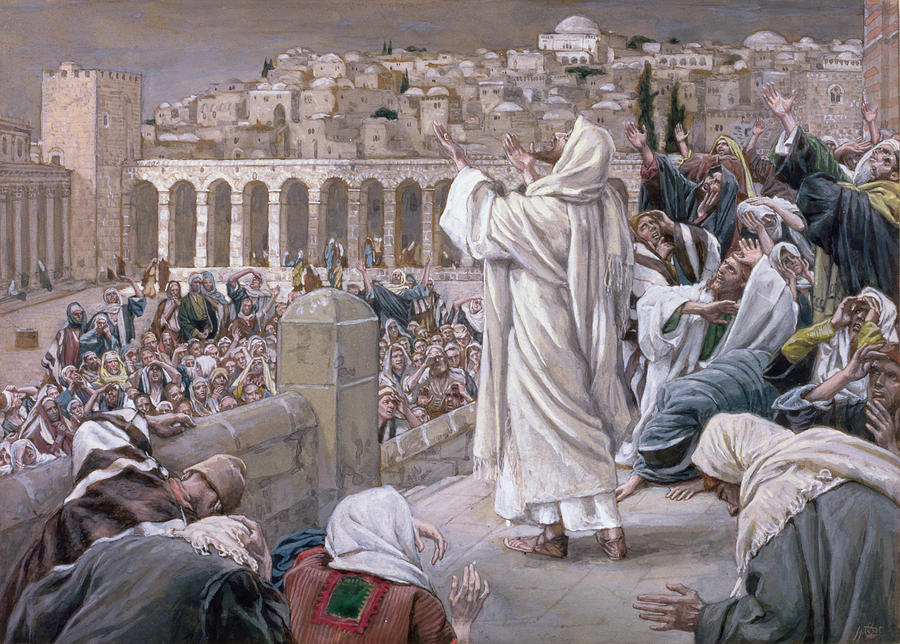
James Tissot, "The Voice from Heaven"

and I will glorify it again.” 

29Then the crowd that was standing there and had heard it kept saying it had thundered, but others started to say, “An angel has spoken to him.” 30Jesus answered and said, “This voice has come not for my sake but for yours.

31                    Now is judgment upon this world.

Now will the ruler of this world be cast out.

32                    And when I am lifted up from the earth,

I will draw all to myself.”

33This he said, indicating by what kind of death he was about to die. 34Then the crowd answered him, “We have heard from the Law that the Christ continues to live forever. How are you saying that the Son of Man must be lifted up? Who is this Son of Man?” 35Jesus said to them,

“The light is with you for a little while more.

Walk around while you have the light,

so that the darkness does not overtake you.

The one who walks around in darkness

 does not know where he is going.

36                    While you have the light,

believe in the light,

that you may become the children of light.”


Jesus said these things, and after he had left, he hid from them.


[1] Verse 26, which is translated as “But if ye do not forgive, neither will your Father which is in heaven forgive your trespasses” in the KJV, in only found in later, Byzantine manuscripts. It is missing in the earliest, most reliable Greek manuscripts and was probably inserted here by later scribes by comparison with Matthew 6:15 (see Metzger, Textual Commentary, 93)

[2] Brown, Gospel according to John, cxxxiicxxxv; Huntsman, The Gospel of John,” 314.